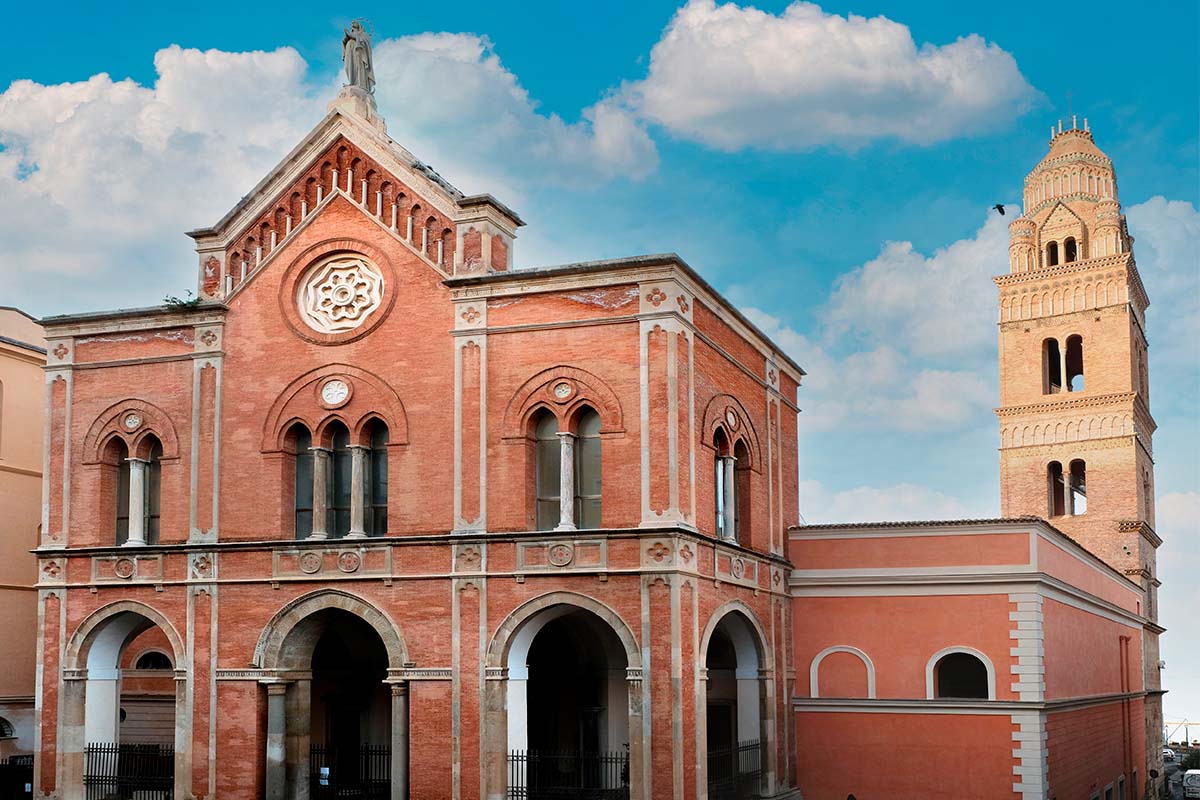
The GaetaCathedral, also known as the Cathedral of Saints Erasmus and Marcian and St. Mary of the Assumption (Cattedrale dei Santi Erasmo e Marciano e di Santa Maria Assunta), serves as the main Catholic place of worship in Gaeta, Italy. It acts as the mother church of the Archdiocese of Gaeta and as the seat of the parish of Mary Most Holy Assumed into Heaven (Maria Santissima Assunta in Cielo). The cathedral holds significant religious, cultural, and historical importance for the city and surrounding region.
The cathedral’s origins trace back to the 9th century. The church was built on the site of the earlier Santa Maria del Parco. They demolished the old church to make way for the new structure. Over the years, people expanded and renovated the cathedral. In the 13th century, it gained a seven-aisle structure, which remained largely intact despite later additions. For instance, the Lazzari family carried out major renovations during the 17th century. They constructed the current apse and crypt, which date back to the end of the previous century.
In the last quarter of the 18th century, Pietro Paolo Ferrara directed another important transformation. His design gave the interior of the cathedral its present look. The cathedral’s layout and design now reflect a mix of different architectural styles, showcasing the passage of time.
The cathedral also features a neo-Gothic facade, built between 1903 and 1904 and completed in 1950. This addition contrasts with the older sections of the cathedral, offering a sense of grandeur and elegance.
The cathedral’s importance did not go unnoticed. Pope Pius IX elevated the GaetaCathedral to the rank of minor basilica on December 10, 1848. Additionally, Italy recognized it as a national monument on January 18, 1941. Thus, the cathedral attracts visitors and pilgrims from around the world. Its historical transformations and continued significance make it a symbol of religious devotion and cultural heritage. The cathedral remains a testament to the city’s rich spiritual and architectural legacy.
Connectivity to Cathedral Basilica of Gaeta, Italy
The Cathedral Basilica of Gaeta is a significant religious and cultural landmark in the city. Known for its rich history, stunning architecture, and spiritual importance, the cathedral attracts visitors from around the world. Fortunately, the Cathedral Basilica of Gaeta is easily accessible through various transportation options, whether by air, rail, or road.
By Air
The closest airport to the Cathedral Basilica of Gaeta is Naples International Airport, located approximately 100 kilometers from the cathedral. This airport handles both domestic and international flights. From the airport, visitors can take a taxi, rent a car, or use public transportation to reach Gaeta. Alternatively, travelers can fly into Rome Ciampino Airport, about 150 kilometers away, or Rome Fiumicino Airport, about 160 kilometers away, and then take a train or drive to Gaeta.
By Rail
The nearest railway station to the Cathedral Basilica of Gaeta is Formia Railway Station, located around 10 kilometers from the cathedral. Formia is well connected to major Italian cities like Rome and Naples by regular train services. From the station, visitors can take a taxi, a bus, or drive to Gaeta, making it an easy trip to reach the cathedral.
By Road
The Cathedral Basilica of Gaeta is conveniently located in the city center, making it easily accessible by car or taxi. Visitors traveling by car can take the SS213 or SS7 roads to reach Gaeta from Rome or Naples. Additionally, Gaeta is well-served by public buses that connect various parts of the city to the cathedral, allowing for easy exploration from different areas of the town.
With these various transportation options, the Cathedral Basilica of Gaeta remains a prominent and easily accessible destination. Whether arriving by air, rail, or road, visitors can easily explore this historic church and experience its rich cultural and spiritual significance in the heart of Gaeta.


 Verified listing