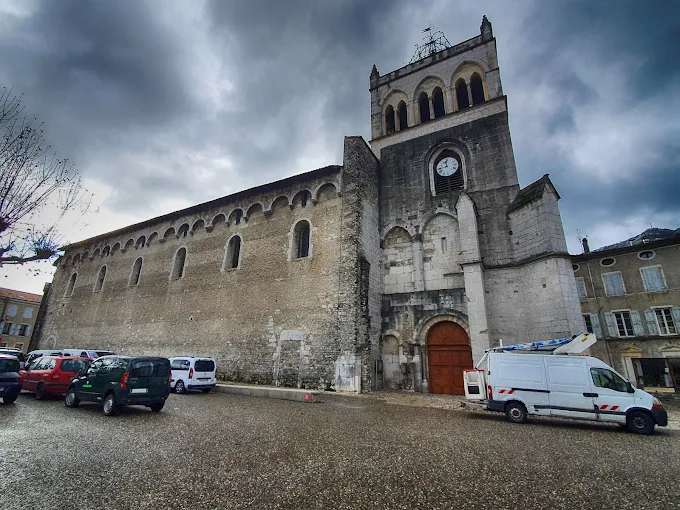
Notre-Dame Cathedral in Die is a very important church because it served as the center of the bishopric from the fourth century. Therefore, it guided people in faith, culture, and city life for many generations. Bishops worked in the cathedral, giving sermons, leading meetings, and helping the community. This work made Die an important city in the church network of southeastern France. Later, in the twelfth century, builders and church leaders constructed the cathedral we see today. They used Romanesque style and added new ideas. The building became strong, balanced, and beautiful. As a result, the cathedral showed stability and devotion. People could worship, pray, and join community rituals while feeling peace and faith.
At the same time, the cathedral shaped the city because houses, markets, and public places grew around it. This connection linked religious life with daily life and work in Die. Then, in 1801, the government changed church rules and joined the bishopric of Die with Valence. This ended hundreds of years of independent bishops. After that, people began to value the cathedral for its history and beauty. Therefore, in 1840, the government listed it as a historical monument. This decision protected the building and encouraged repairs, research, and public appreciation. Today, visitors can feel history in every stone, arch, and space. They can see stories of faith, power, and life across centuries. Ultimately, Notre-Dame Cathedral in Die is not just an old building. It is a symbol of strength, culture, and faith, continuing to tell the story of the city, the church, and the people through time.
The nearest airport is Grenoble Alpes–Isère Airport, approximately 120 km from Die Cathedral. Another option is Lyon–Saint Exupéry Airport, about 180 km away. From both airports, travelers can hire a car or take a train and bus combination to reach Die.
Railways
The nearest railway station is Die Train Station (Gare de Die), located about 1 km from the cathedral. Regional TER trains connect Die to Valence TGV Station, which links to major cities such as Paris, Lyon, and Marseille. From Valence, travelers can take a connecting TER train directly to Die.
Roadways
Die is well connected by road. From Valence, it is approximately 60 km, accessible via the D93 and D541 roads. Buses from Valence and nearby towns serve Die several times a day. Travelers can also drive from Grenoble (approx. 120 km) or Lyon (approx. 180 km) via highways A49 and D93/D541. Within Die, the cathedral is located in the city center, easily reachable on foot from parking areas or local bus stops.


 Verified listing