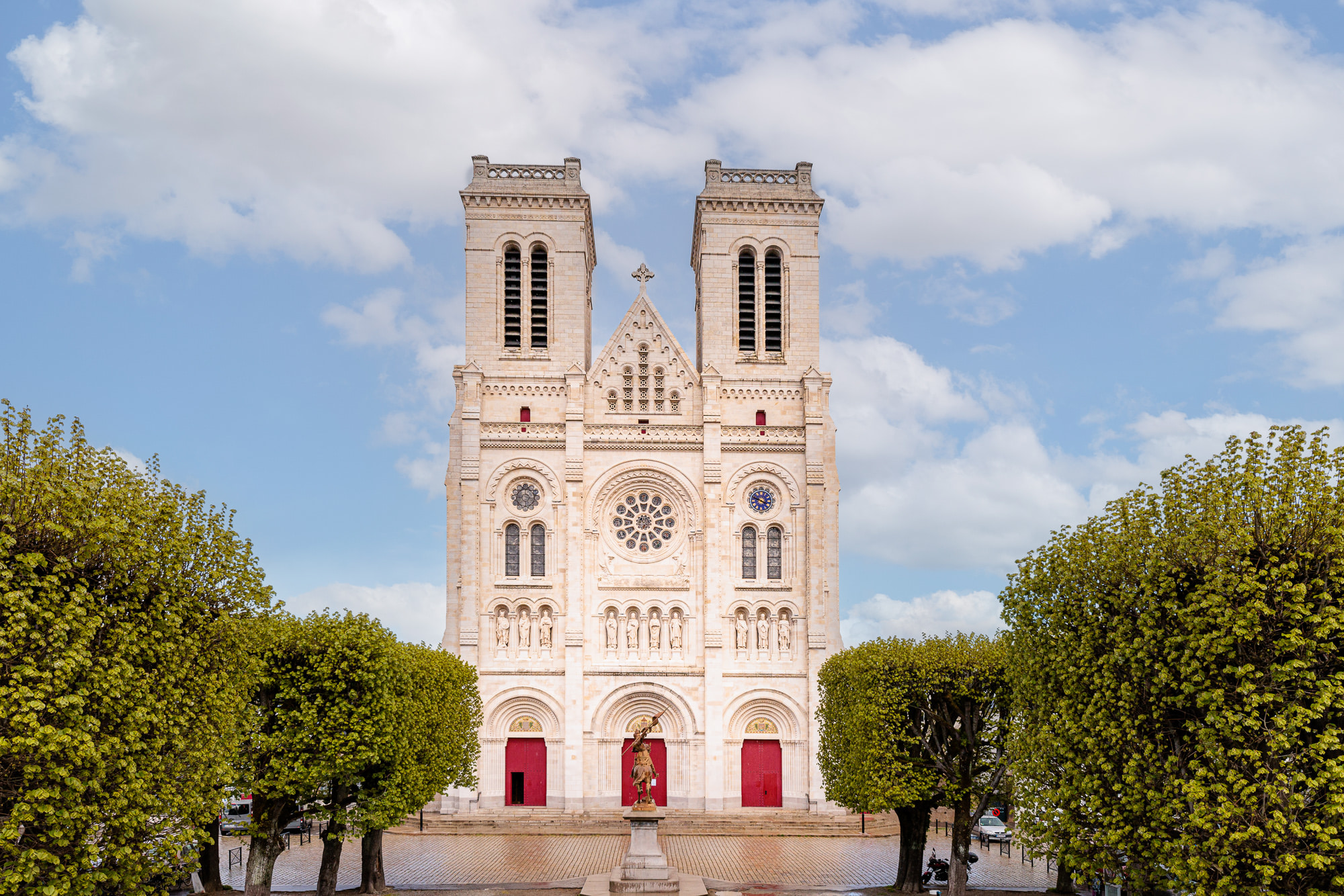
Basilica of St. Donatian and St. Rogatian, Nantes, France
The Basilica of Saint-Donatien-et-Saint-Rogatien, located in the Malakoff-Saint-Donatien district of Nantes, is a major monument. Built in the 19th century in the Neo-Romanesque style, a style that blends tradition and modernity, its imposing and captivating façade, which overlooks the Place des Enfants-Nantais, is dedicated to Saint Donatien and his brother Saint Rogatien, two 3rd-century Christian martyrs who are emblematic figures in local Christian history.
The building was designed to accommodate Nantes' growing population at the time. In addition to the basilica, the site includes a historic cemetery where several prominent figures from Nantes are buried. This cemetery adds a memorial dimension to the site. The Saint-Étienne chapel, a listed historical monument, further enhances the site's significance.
The Neo-Romanesque style is characterized by arcades, clean lines, and a strong vertical emphasis. This architecture echoes the great basilicas of antiquity while incorporating modern elements. The site is an important spiritual and cultural center for Nantes, attracting numerous visitors each year, fascinated by its history and heritage.
In short, the Basilica of Saint-Donatien-et-Saint-Rogatien represents an essential element of Nantes' heritage. This historic site, with its basilica, cemetery, and chapel, tells the story of the city through the centuries. It continues to be a place of reflection, remembrance, and discovery for all.
To reach Air, Rail, and Bus services, you typically follow these steps:
Air (Airport) To reach an airport, you can use the following transportation methods:
By Car or Taxi: Drive directly or take a taxi to the airport's designated drop-off area. Public Transport (Bus/Metro): Many airports are connected to the city center by dedicated buses, metro lines, or light rail systems. Check local schedules for specific routes. Airport Shuttle Services: Some cities provide shuttle buses from major hotels or central points to the airport.
Rail (Train Station) Train stations are usually accessible by several modes of transportation:
By Car or Taxi: You can drive or take a taxi directly to the station. Public Transport: Most cities have a well-connected public transportation network (metro, buses, or trams) that links the city center to the major train stations. Bicycle or Walking: In some cases, train stations are close enough to walk or cycle from residential or central areas.
Bus (Bus Station) Bus stations are generally well-connected within cities:
By Car or Taxi: You can drive to the bus station or take a taxi, which is often the quickest option. Public Transport: Most bus stations have nearby metro, tram, or local bus stops. Check timetables for routes and connections. Walking or Cycling: In urban areas, many bus stations are within walking or cycling distance from residential or business areas.
In Summary: Air (Airport): Taxi, private car, public transport (metro/bus), airport shuttle. Rail (Train Station): Taxi, car, metro, bus, walking. Bus (Bus Station): Taxi, car, local bus, metro, walking.
It’s best to check specific transportation routes and timetables for the most efficient route to your destination.
Map Location
Mass Schedule
Monday 09.15 AM and 12.00 PM Tuesday 09.15 AM and 06.00 PM Wednesday 09.15 AM and 12.00 PM Thusday 09.15 AM and 12.00 PM Friday 09.15 AM and 12.00 PM Saturday 08.00 AM and 6.00 PM Sunday 09.00 AM and 11.00 AM
Book Now
Open
Open hours today: 8:30 am - 7:00 pmToggle weekly schedule


 Verified listing