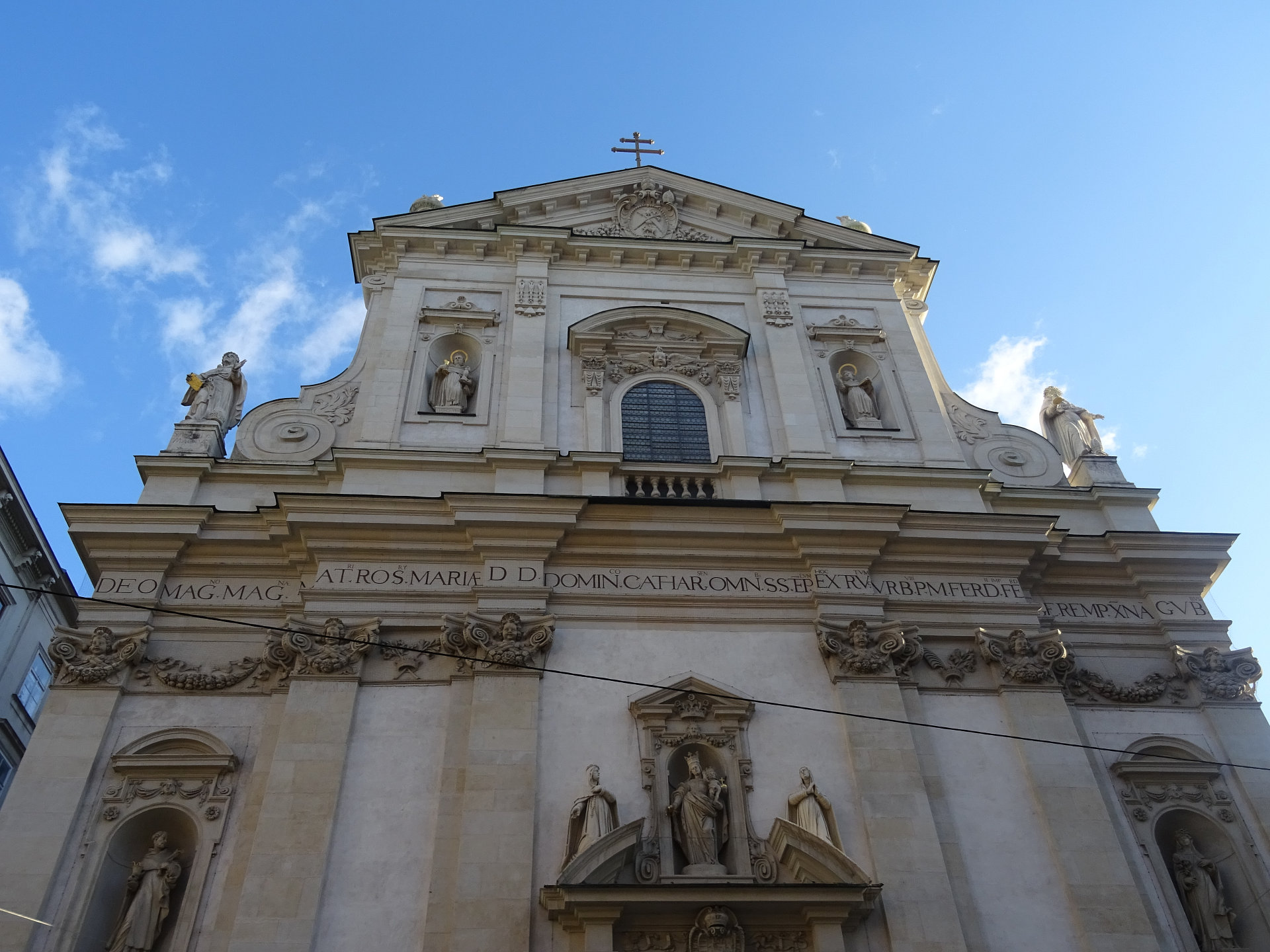
The first church on this site, built in 1237, was established by the newly arrived Dominicans. Duke Leopold VI allocated the land in 1225-1226. Between 1240 and 1270, builders expanded the church significantly, adding a new choir in 1273. However, a series of fires required the construction of a new Gothic church from 1283 to 1302. During this time, builders extended the nave from 1458 to 1474, creating a nave with five cross vaults and two aisles.
During the first Turkish siege of Vienna in 1529, the church sustained significant damage. The siege led to the demolition of the choir and partial destruction of the nave. Following this event, the church fell into increasing disrepair over the years.
As awareness of the Counter-Reformation grew, the Dominicans recognized the church's condition as unacceptable. In 1631, they began constructing a new oblong church with a dome, designed by architect Jacopo Tencala, who had previously worked for Prince Maximilian of Liechtenstein. Additionally, master builders Jacopo Spacio, Cipriano Biasino, and Antonio Canevale introduced the Baroque style to Vienna.
On May 29, 1631, Emperor Ferdinand II laid the foundation stone. Builders completed the structural work by 1634, and the church held its consecration on October 1, 1634. Craftsmen added final touches by 1674. Finally, in 1927, the church received elevation to basilica minor and was renamed “Rosary Basilica ad S. Mariam Rotundam,” marking a significant chapter in its rich history.
To reach the location described, the specific transport options can vary depending on the exact city and country. Given that the church is located in Vienna, Austria, here’s how you can get there by air, rail, and bus:
By Air:
Fly to Vienna International Airport (VIE): This is the primary international gateway to Vienna. From the Airport:By Train: The City Airport Train (CAT) or the S-Bahn (S7) connect the airport to Vienna's central train station (Wien Hauptbahnhof) in about 15-30 minutes. By Taxi or Ride-Sharing: Taxis and ride-sharing services are available and typically take around 20-30 minutes to reach central Vienna, depending on traffic. By Rail:
Arrive at Vienna Hauptbahnhof (Vienna Central Station): This is the main train station in Vienna and connects to various domestic and international destinations.From the Station:By Tram/Bus: Depending on the church’s location, you might need to take a tram or bus from the central station. Vienna has an extensive public transport network. For instance, tram lines or bus routes might directly or indirectly lead to your destination. By Taxi: Taxis are available at the station and can take you directly to the church. By Bus:
Arrive at Vienna International Busterminal (VIB) or other major bus stations like Erdberg Bus Terminal:From the Bus Station:By Tram/Bus: Check the local public transportation options. For example, trams or buses can connect you from the bus terminal to various parts of the city. By Taxi: Taxis are available at major bus terminals and can provide a direct route to the church. Public Transport in Vienna: U-Bahn (Subway): Vienna’s U-Bahn system is efficient for getting around the city. Tram: Various tram lines operate throughout the city and might stop near the church.
Bus: Buses complement the tram and U-Bahn systems, covering routes not served by other modes.
To get the most accurate and up-to-date routes, check Vienna’s public transportation website or use a navigation app to plan your trip.
Map Location
Mass Schedule
Holy Masses
Sa (Eve Mass): 6pm Sun and holidays:
10 a.m. (for the parish) 12 o'clock (in Latin)8pm Mon-Fri: 6pm
Book Now
Open
Open hours today: 7:00 am - 7:00 pmToggle weekly schedule


 Verified listing