Besançon Cathedral, known in French as Cathédrale Saint-Jean de Besançon, stands in the heart of Besançon, France. Moreover, it serves as a Roman Catholic church dedicated to Saint John and functions as the seat of the Archbishop of Besançon. This dual role makes it a significant spiritual and historical landmark.
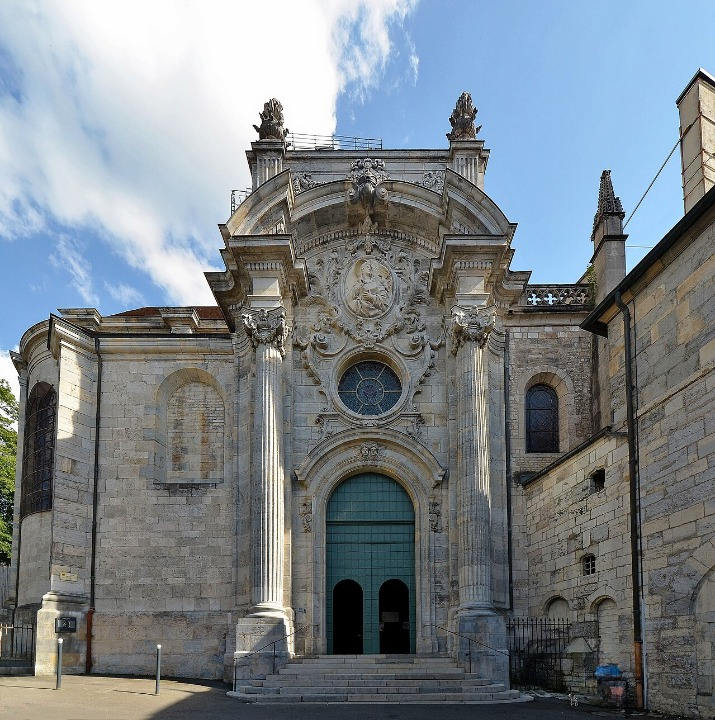
The cathedral features a large nave flanked by two aisles. During its construction, which took place between the 11th and 13th centuries, builders blended Romanesque and early Gothic styles. As a result, the building has a distinctive appearance that continues to captivate visitors and scholars alike.
Inside, two facing apses each contain an altar. Interestingly, this layout reflects the design of contemporary German cathedrals, which intentionally omit a main transept. Therefore, the interior emphasizes the ceremonial focus of the space. The Romanesque arches, dating to the 13th century, frame the nave elegantly. Additionally, the choir was rebuilt in the 18th century and introduces Baroque elements, which contrast with the older medieval structure. This combination creates a layered sense of historical evolution.
The cathedral sits near the base of Mont Saint-Étienne, below the historic citadel, giving it a commanding presence in the city. To the east, visitors find the 16th-century Porte Rivotte, featuring twin round towers and 19th-century pedestrian walkways. Meanwhile, to the west stands the Porte Noire, a Roman triumphal arch from the 2nd century adorned with intricate sculptural decoration. Together, these landmarks highlight a striking dialogue between Roman antiquity and medieval ecclesiastical architecture.
Saint John’s Cathedral is more than a place of worship. Indeed, it also serves as a vivid testament to Besançon’s rich cultural and historical heritage.


 Verified listing