The Basilica of Sant'Andrea in Vercelli stands as one of the most important monuments in the region. It is the first Gothic building in Piedmont and one of Italy's earliest examples of Gothic architecture. The basilica combines Romanesque and Gothic styles. It brings together the local Romanesque elements with the new Gothic influences from the Cistercian order. This combination creates a distinctive architectural style that bridges tradition and innovation. Furthermore, the basilica holds the title of a minor basilica, which adds to its significance.
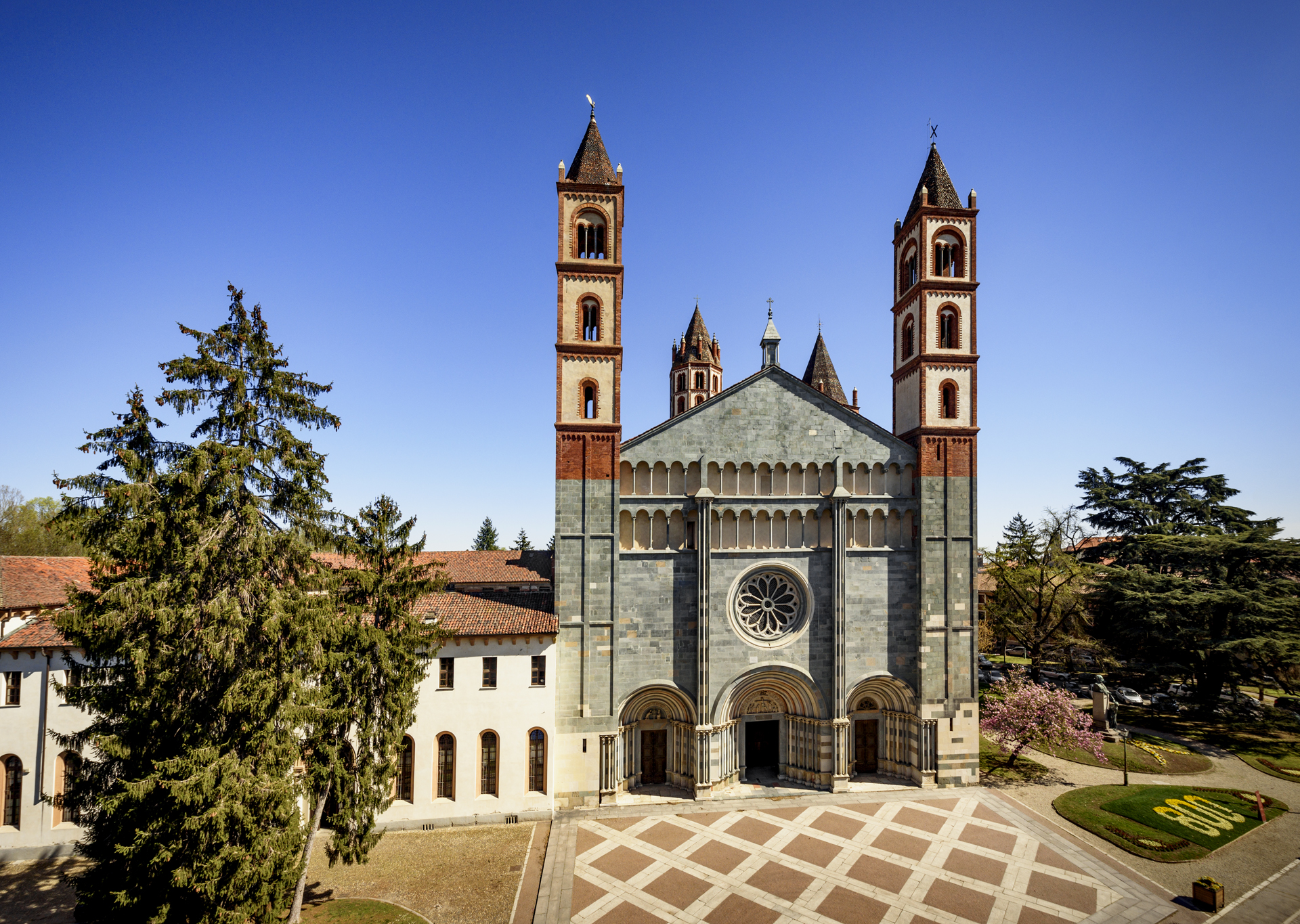
Cardinal Guala Bicchieri ordered the construction in 1219, and the basilica was completed in 1227. The design clearly showcases Romanesque traditions, especially in the gabled façade and small arched loggias. At the same time, the building integrates Gothic elements, which mark a shift in architectural style. For instance, the narrow façade, flanked by two towers, stands out as a rare feature in northern Italy. It includes three splayed portals, and two bundles of small columns surround the central portal. These columns lead into a loggia that separates the façade from the classical-style triangular pediment. Additionally, the large rose window, placed at the intersection of the diagonals, enhances the structure's visual impact.
The basilica’s exterior features a striking combination of materials, including white plaster, red brick, and green accents. These materials create a rich, vibrant appearance. The octagonal dome, topped with a high lantern, further elevates the basilica’s grandeur. Flying buttresses support the structure, ensuring its stability. Inside, the church follows a Latin cross plan, and the rectangular-shaped choir adds to the space’s elegance.
Benedetto Antelami designed the lunette above the central portal, which depicts Saint Andrew’s martyrdom. Experts, such as Giulio Carlo Argan, argue that Antelami also designed the entire basilica, underscoring his profound influence on the building’s architectural vision.
Connectivity of Basilica of Saint Andrew in Vercelli, Italy
The Basilica of Saint Andrew in Vercelli, Italy, enjoys excellent connectivity by air, rail, and road. The city is easily accessible from major Italian cities and international destinations.
Airways
The nearest major airport is Malpensa Airport (MXP) in Milan, which is located approximately 80 km from Vercelli. Train: From Malpensa, you can take a direct train to Milan Centrale, and then transfer to a train to Vercelli. The total journey takes around 1.5 to 2 hours. Bus: Alternatively, you can take a bus from Malpensa to Milan Centrale, and then catch a train to Vercelli.
Railways
Vercelli is well-served by Vercelli Railway Station, which connects the city to major Italian cities.
From Milan Centrale, you can board a direct train to Vercelli, with a travel time of around 1 hour.
Roadways
Vercelli is also accessible by bus from nearby cities such as Milan, Novara, and Turin.
The bus journey from Milan to Vercelli takes around 1.5 to 2 hours, and once you arrive at the Vercelli Bus Station, the Basilica of Saint Andrew is just a short walk away.
With its central location, the Basilica of Saint Andrew is easily accessible by all major transportation options.


 Verified listing