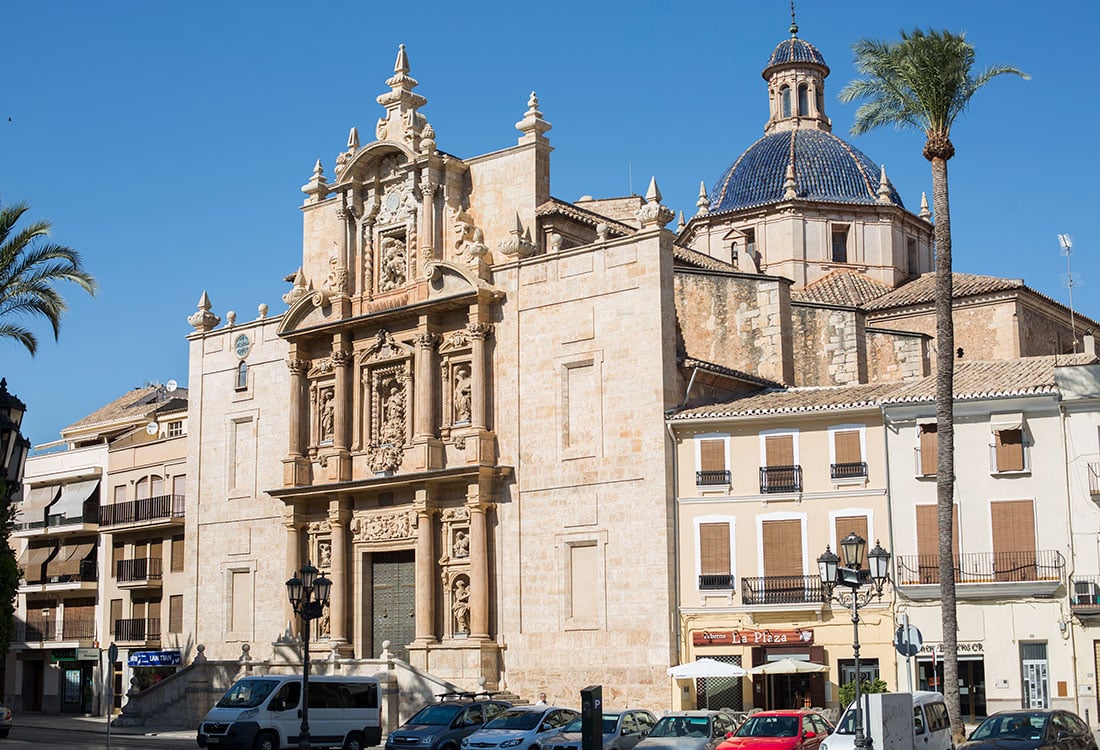
The Archpriestal Basilica of the Assumption of Our Lady in Liria dates to the 17th century. It reflects the Baroque style, rich in detail and form. Inside, three naves stretch forward, marked by semicircular arches. Moreover, a striking dome rises above the transept, commanding attention. Pablo Albiniano de Raxas designed this dome in 1626. However, Pedro Ambuesa modified the original plan in 1634 to improve its form.
Furthermore, the church’s façade mirrors the style of the Monastery of San Miguel de los Reyes in Valencia. Sculptor Tomás Lleonart created the façade as a grand three-tiered altarpiece. In addition, he added a dramatic double staircase, increasing its visual impact.
Inside the basilica, visitors also find several notable artworks. Among them stands a ceremonial canopy designed by Vicente Traver. Originally made for the Holy Cathedral of Valencia, it now adds grace to this sacred space.
At the center of the choir lies a tomb of blue marble. It honors Jacobo Francisco Fitz-James Stuart and Columbus of Portugal. He was the 3rd Duke of Berwick and Liria and Jérica. A white marble shield crowns the stone. Then, an inscription lists his titles, merits, and his death in 1785.
Meanwhile, the Epistle side of the presbytery holds another mausoleum. This one commemorates María Teresa de Silva y Palafox, last Duchess of Alba of the House of Silva. She died in Florence in 1818. Her son, Carlos Miguel Fitz-James Stuart y Silva, commissioned it. In 1833, José Álvarez sculpted the piece in Rome. He used Greek style and layered white marble. The structure ends in shining Carrara marble. Two grieving figures flank her portrait. Below, her son’s tomb from 1835 completes the tribute.
Connectivity of Basilica of the Assumption of Mary, Lliria, Spain
Airways
The nearest airport to Llíria is Valencia Airport (Aeropuerto de Valencia - VLC), located approximately 35 kilometers away. It operates frequent domestic and international flights, with taxi and bus services available to Llíria.
Railways
Llíria is served by the Llíria Railway Station, which is the final stop on Line 2 of the Valencia Metro (Metrovalencia). Trains run frequently from Valencia’s city center (Estació del Nord or Xàtiva station), offering a convenient and direct route to Llíria.
Roadways
Llíria is accessible by car or bus from Valencia and nearby towns. It lies along the CV-35 highway, also known as the Autovía del Túria. The town is about a 30-minute drive from Valencia. Regular intercity bus services also connect Llíria with surrounding municipalities and Valencia's main bus station.


 Verified listing